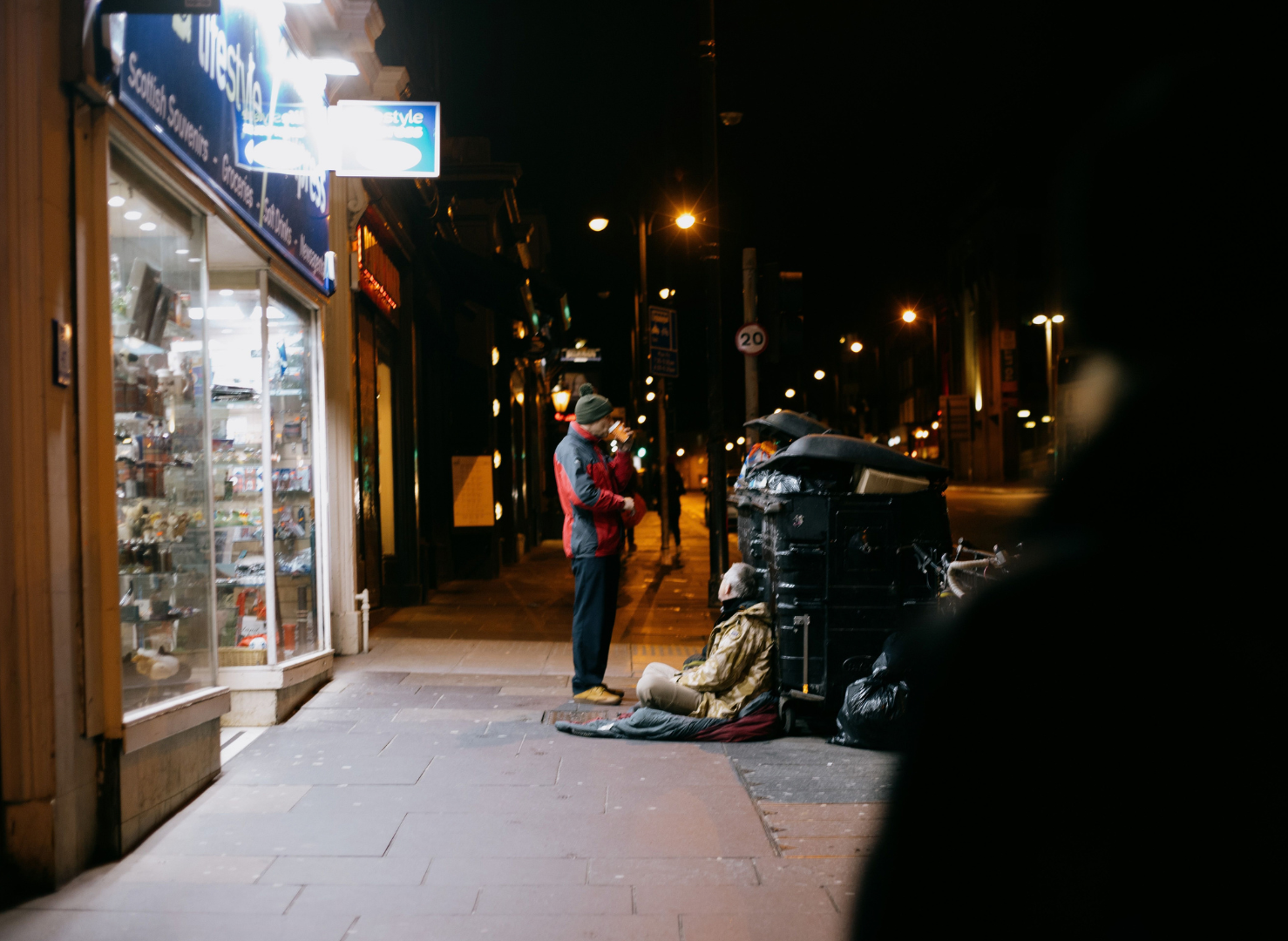
Since taking office, the new government has posed a big question, “can we end rough sleeping by Christmas?”. Backed by a £442 million investment for improving support services, it’s an ambitious vision based on a clear idea: rough sleeping is not inevitable and can be addressed.
At IFF we’ve gathered a lot of data from people experiencing homelessness and frontline practitioners. These projects have shown time and time again that rough sleeping happens when several things fail at once, across housing, welfare, health, employment support, immigration and local services. And it emerges when a series of small gaps, delays, and obstacles are built up over time. So we also need to ask what does ‘in’ actually mean, and what happens afterwards?
Ahead of this autumn’s summit on implementing the new National Rough Sleeping Programme, we take a look at what the lived experience of rough sleeping and homelessness has taught us about what meaningful support looks like in practice.
Invest to make emergency and temporary accommodation a better space for recovery
A useful test for any rough sleeping strategy is not just whether it can find someone a bed for a night, but whether it can help them sustain a safer life afterwards. We frequently hear about people feeling trapped in places where anti-social behaviour, substance use, poor living conditions or isolation make it harder to address the issues that contributed to their homelessness in the first place. Managing these day-to-day challenges can also be so demanding that there is little capacity left to properly think about employment, training, healthcare or wider recovery goals.
There is already strong learning from more than 100 ‘Housing First’ programmes in the UK, but the challenge is creating the conditions to scale them well: enough suitable homes, sustained revenue funding, skilled multidisciplinary teams, and upholding the principles that make the model effective in the first place. Other emergency accommodation models will be necessary in the short term, and set-up quickly to meet the Government’s ambition. But, if speed of delivery means accommodation is commissioned without embedded support, it can risk recreating conditions that led to rough sleeping in the first place.
“Something about having a room with a door I can lock and take a shower whenever I want. That’s what makes me feel safe and calm. I don’t have to ask anyone, or wait for the shower, or make chitchat when I’m not in the mood. It’s my choice. That made me feel safe.”
A person sharing their experience of the Respite Rooms pilot programme, accommodation for victim-survivors of Domestic Abuse who are at risk of rough sleeping.
Disjointed eligibility and rules mean accommodation does not always create a route into sustained support. Frontline staff have described situations where someone is eligible for help from one part of the system, but falls below the threshold for another when they are already in crisis. The government’s recent Housing Benefit changes, affecting how much those in temporary and supported accommodation earn before losing support, is a useful example of important technical changes that can ensure accommodation support doesn’t limit people’s recovery goals.
“If someone’s not been [living here] for a minimum of six months, that also limits what they can actually access which also is a bit sort of disheartening to the client because they actively want support, and we are limited with what we can offer.”
Drug and alcohol support provider, participating in our research for the Greater London Authority.
Anchor the system around trusted relationships
Relationships are often treated as having less weight in these processes, when they are actually one of the most important ways to initiate change. When people reflect on what helped them move forward, they often talk less about specific programmes or policies than about individuals who took time to listen, stayed in touch, and followed through on commitments.
This matters because people experiencing homelessness are often required to engage with multiple professionals and repeatedly explain difficult life experiences. Beyond being time consuming, repeatedly revisiting traumatic experiences can be exhausting and may discourage some people from continuing to engage.
We have heard examples of outreach workers accompanying someone to their first appointment, peer mentors helping people understand unfamiliar services, or support workers acting as the bridge between multiple agencies involved in someone’s life. Trusted support staff can often act as the thread that connects otherwise fragmented systems, or they can tailor support to individual needs.
“[Staff member] collected me from the [local hostel]. She came after hours, just to get me. Some people would be like, it’s after 5pm, bye, but not her. She carried my suitcase. There are nice people in the world.”
A person sharing their experience of the Respite Rooms pilot programme.
The challenge for policymakers is how to build systems that create the conditions for these relationships to thrive and develop.
This goes hand in hand with a bigger focus on partnership working, prevention and joining up support around people’s wider needs. Promisingly, initiatives like Neighbourhood Health and evidence from piloted programmes like our work on Respite Rooms, show the positive results of relationship building across joined-up services. They just need to be more widespread and accessible.
Co-design services to reflect different journeys into and out of homelessness
There is no single homelessness experience. Someone leaving prison, someone fleeing domestic abuse, and someone newly granted refugee status may all present as homeless but require very different forms of support to rebuild their lives.
Small design choices can become make access difficult. Language, appointment times, documentation requirements, digital access, previous experiences of statutory services, and uncertainty about immigration or benefits rules, can all shape whether someone seeks help.
Simple adaptations can make a significant difference: providing information in multiple languages, offering peer support from people with shared experiences, adapting appointment routes, using trauma-informed communication, and building in trusted intermediaries to reach more people that need help.
“Do the people only speak English on the reception? I wouldn’t know what to do then and would probably leave.”
A person from a Polish background, sharing their experience of rough sleeping and accessing drug and alcohol support in our research for the Greater London Authority.
People with lived experience and the organisations already trusted within communities are best placed to help implement those changes. In our participatory research, we’ve increasingly partnered with voluntary, community, faith and social enterprise (VCFSE) organisations whose networks, local knowledge and established relationships help us reach people who may not respond to traditional research or consultation routes. And the same principle applies to shaping the eventual provision. VCFSE organisations often understand where systems feel unsafe, inaccessible or disconnected, which helps make them more credible and usable from the start.
Having more joined-up local data systems is essential for relationship-building too. Inconsistent definitions and limited data linkage can make it tricky to see people’s journeys across support systems. A national drive to end rough sleeping should also be a national opportunity to improve data linkage, even where services are commissioned at pace.
In summary
Designing a system which helps more people move through into sustained support, security and recovery starts with directly hearing from the voices of those with lived experience.
The immediate opportunity is to combine the urgency of the Government’s ambition whilst also applying recent evidence and learnings from research.
If accommodation is commissioned quickly, support should be built in from the start. If new pathways are created, data should follow people’s journeys rather than only counting placements. And if services are redesigned, people with lived experience and the VCSE organisations trusted by communities, should help test whether they are genuinely accessible, safe and usable.
For more on our work exploring support for people experiencing homelessness, have a look at:
- Respite Rooms Pilot Programme Evaluation (2023)- for the Ministry of Housing, Communities and Local Government.
- Survey of disadvantaged groups on Universal Credit and Qualitative research with disadvantaged groups on Universal Credit (2026) – for the Department for Work and Pensions.
- Research into drug and alcohol support needs of non-UK nationals that were rough sleeping (2025) – for the Greater London Authority.
- Our early reflections on delivering the evaluation of Individual Placement and Support — for the Centre for Homelessness Impact.