
In this sixth and final project showcase, we look at our evaluation of the Respite Rooms pilot programme, designed to support a group of people that were experiencing homelessness and were also survivors of domestic abuse at risk of falling through the cracks of existing support systems.
The Respite Rooms pilot programme was launched to support a group of people facing difficult circumstances – primarily women experiencing both street homelessness and domestic abuse – whose are at risk in homeless hostels, but whose support needs make them unsuitable for traditional refuges. The pilot supported nearly 800 people. We were commissioned by the then Department for Levelling Up, Housing and Communities (DLUHC) to evaluate its effectiveness. The Department has since changed its title to become the Ministry of Housing, Communities and Local Government (MHCLG).
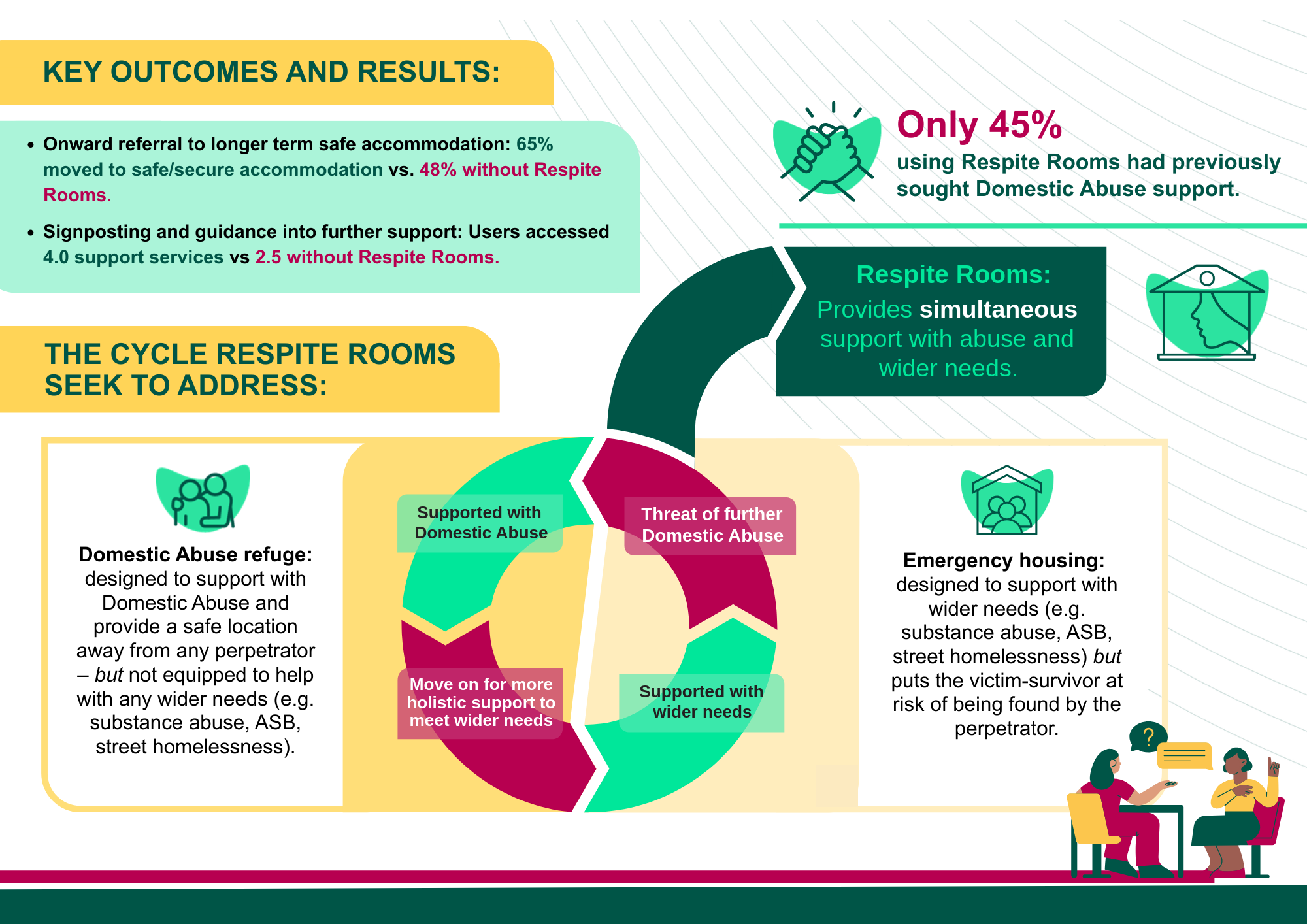
The findings revealed a significant positive impact: 65% of service users moved to safe/secure accommodation against 48% in the comparison group, and accessed an average of 4.0 support providers compared to 2.5. The research generated strong interest from local authorities in implementing the model at scale, with over 150 delegates attending a workshop on the subject.
About the client
The Department for Levelling Up, Housing and Communities (DLUHC) focused on reducing regional inequalities and empowering local government. Operating under the previous government, its priorities included improving housing and infrastructure, as well as strengthening local economies and communities.
The challenge
Experiences of domestic abuse and homelessness are often interconnected, with many people experiencing abuse also facing housing instability, and rough sleeping also increasing the risk of abuse. Practitioners and service providers began to recognise a group often underserved, made up mostly of women, that were falling through the cracks of existing support systems.
These women are often ineligible for domestic abuse refuges due to additional needs such as drug addiction, mental health issues, alcoholism, or involvement in sex work. On the other hand, homeless hostels are unsafe alternatives, where abuse perpetrators may easily find them. As a result, these women can become caught in a relentless cycle of evictions, arrests, and unsuccessful crisis interventions, which not only compound their trauma, but also place a financial and operational strain on public services such as the police, NHS and local authority outreach teams.
A new concept began to emerge in response to the overlapping challenges of these two issues, initially at St. Mungo’s in Westminster. Their ‘Green Room’ concept was to create a new kind of accommodation: a safe, trauma-informed space that sat somewhere between a shelter for those experiencing homelessness and a refuge for victim-survivors of domestic abuse. Crucially, these spaces would be in secret locations to protect residents from further harm. They would offer not only accommodation but also wraparound support and advice, tailored to the complex needs of each individual.
Based on the Green Room concept, the Department provided £5.4 million to fund the Respite Rooms pilot in from October 2021 to March 2023 across 12 local authorities. The pilot offered short-stay accommodation with intensive support to help vulnerable people affected by domestic abuse and sexual violence avoid rough sleeping and get out of danger.
IFF was commissioned, in partnership with Bryson Purdon Social Research (BPSR), to evaluate the effectiveness of the Respite Rooms pilot programme. The evaluation aimed to assess whether the model worked, understand its impact, and encourage future investment.
The approach
Due to the complex nature of the topic, we conducted a theory-based, mixed-methods evaluation to ensure a comprehensive assessment of the programme over 18 months.
The evaluation began with a feasibility study, which included a literature review, policy analysis, and stakeholder interviews. This phase helped shape a Theory of Change and identify key challenges such as the small scale of the pilot, the difficulty of tracking individuals with limited service engagement histories, and the unpredictability of long-term outcomes.
The main evaluation phase included:
- In-depth interviews with national stakeholders, local authority leads, and service providers.
- Case studies of six Respite Room pilot sites, offering rich, qualitative insights into how the model operated on the ground.
- Anonymous, trauma-informed interviews with service users, supported by ethical protocols, buddy systems, and escalation procedures.
- Analysis of Management Information (MI) data from nine of the twelve pilot sites.
- A Quasi-Experimental Design (QED) comparing outcomes for Respite Room users with a matched comparison group, compiled by service operators.
The Respite Rooms pilot faced several operational challenges. Maintaining staffing levels proved difficult, which affected the delivery of consistent care and support. There were difficulties keeping track of how service users were interacting and working with outside organisations, who provided extra support with their specific needs. A shortage of suitable move-on accommodation led to extended stays beyond the intended four to six weeks, which in turn limited the number of individuals the programme could assist. This also made the evaluation harder, as a reduced number of service users meant fewer outcomes to measure.

The impact
The Respite Rooms pilot supported nearly 800 people; by study of outcomes in several Respite Rooms, the evaluation revealed a statistically significant positive impact, a rarity in research assessing programmes seeking to assist people experiencing homelessness or domestic abuse:
- 65% of Respite Room users moved to safe or secure accommodation, compared to 48% in the comparison group, of potentially eligible service users turned away or not referred.
- Users accessed an average of 4.0 support services, compared to 2.5 among the comparison group.
- Qualitative feedback from victim-survivors, as well as staff, was overwhelmingly positive. Many staff had known some of the women for years through rough sleeping support services, and often said they never believed they’d escape rough sleeping. But the Respite Rooms provided the support and security they needed to get them back on their feet.
The programme also offered flexibility to local authorities, allowing them to tailor services to local needs. Services varied substantially in terms of scale, physical design, and the range of support they offered on-site. This adaptability enabled the Respite Rooms to fill gaps between services which were different in each area.
In February 2023, we hosted a national workshop to share the findings. Over 150 local authority delegates attended showing the appetite for innovative, evidence-based solutions to homelessness and domestic abuse.
Encouragingly, 10 out of 12 pilot sites had secured continuation funding at the time of follow-up interviews being conducted. Some secured additional support through initiatives like the Rough Sleeping Initiative, charitable grants, and New Burdens Duty funding, which allocated funding to local authorities to support the cost of delivering Welfare Reform changes introduced by the Conservative government.
Including more perspectives
While the findings demonstrated clear impact, there are a number of other avenues and challenges to explore.
One Respite Room case study included a male Respite Room model – aimed at a distinct group of men whose homelessness was related to their vulnerability to abuse and exploitation. These men might for example be at risk of being drawn into substance abuse or criminal activity if placed in traditional accommodation. This research highlighted that this group was quite distinct in some ways from the female service users, pointing to a valuable area for future research.
The study also could have benefited from pulling in other perspectives such as the police, NHS, and Independent Domestic Violence Advisers (IDVAs) to provide a more holistic view, potentially providing a better understanding of systemic issues and the wider impact on other services of Respite Rooms.
Participant quotes
Without a doubt it’s been a success … it’s saved lives … it’s filled gaps … [before the Respite Room project] some people really fell through and never received the support required.
Local Authority
I went to Crown Court, and I stood up against him in court, I never would’ve been able to do that before, and I did it.
Service user
It’s had a massive impact on the police. They’ve been able to take people to the Respite Room, saving them time trying to find somewhere safe for that person, or instead of putting them in a cell.
Provider
I’m excited about life, I’ve got hope…I’ve got a life to live for, I want to get my son back… I want to get a job and be a working mum for my boy.
Service user
Download the showcase
To find out more about this project, or how we could help you, contact us at hello@iffresearch.com. You can also download the project showcase here: