
Youth unemployment has been on the policy radar for years, but this year marked a turning point.
Across the UK, the number of young people aged 16 to 24 not in education, employment, or training (NEET) reached nearly one million in 2026 – the highest level in over a decade.1
The government has committed to understanding the complex drivers behind this trend through the commission of Alan Milburn’s Young People and Work Review. The interim report, published in May 2026, helped place young people’s opportunities and experiences firmly at the centre of the national conversation.2
But as well as collecting national statistics, part of tackling this challenge includes understanding the perspectives of the young people directly affected.
The Social Mobility Commission (SMC) asked us at IFF to do just this. We explored the first-hand experiences of young people in Blackpool who are NEET, focusing on how local factors may shape their situation.
In this blog, we look at how we gathered those views and what young people told us.
Amplifying the voices of young people
Blackpool offered a particularly important case study for further study. The town has the highest NEET risk score in the North West and the second highest in England.3 Plus, many of the challenges identified in the Young People and Work Review, including the prevalence of insecure and seasonal employment in coastal communities, are relevant to the area.
We used what’s called a Participatory Action Research approach, placing young people at the centre of the research process alongside local community organisations, school leaders and employers.
Participants helped shape the research questions, interpret the findings and develop recommendations for tackling local youth unemployment. This involved:
- Co-design with a separate group of young people with lived experience. The panel contributed to material design, reviewed our findings, and collaborated on how we could share findings in a creative and accessible way.
- Training community organisations to recruit and deliver discussions with young people, drawing on existing local relationships. These organisations were identified based on the type of support they provide, to ensure we spoke to young people with a range of barriers, particularly those known to increase the risk of NEET.
- Workshops with local community organisations, sector experts and employers to understand the complexities of the local system in Blackpool. The context fed into the design by highlighting key focus areas to explore in discussions with young people.
- A deliberative workshop with local young people to develop practical, evidence-informed proposals for change.
By involving the people most affected at every stage, we were able to build a richer understanding of life in Blackpool. It ensured that the findings and recommendations reflected real experiences, real aspirations and real solutions.
Four personas: the journeys young people may take
Through our discussions with 31 young people in Blackpool, we covered a variety of topics, such as family background, experience of school and further education, the welfare system, employment and training, and barriers to receiving support.
Our findings highlighted four journeys (or ‘personas’) to becoming NEET in Blackpool:
- More intensive support needs: These young people were the furthest from reengaging with education, employment or training. They were typically in immediate crisis (e.g. homelessness, full-time caring responsibilities, or involvement of the criminal justice system) and needed to resolve their immediate stability before thinking about longer term goals.
- Health issues constraining ambition: The main barrier for young people in this group were physical / mental health conditions or neurodivergence. While many had achieved GCSEs and had clear aspirations for employment or further study, their daily lives were shaped by their health needs, confidence levels and ability to cope in unfamiliar environments.
- Lack of pathway awareness: These young people were actively looking for work and wanted to progress, but lacked clear pathways, confidence and awareness of opportunities.
- Qualified but misaligned: These young people were generally closest to reengaging with education, employment or training. Though they typically held post-16 qualifications, their skills and experience were usually misaligned with local employment opportunities.
While these experiences are not unique to people in Blackpool, they are shaped by the local context. Particularly high rates of educational and socioeconomic disadvantage in the area limit opportunities early on. Blackpool is also characterised by a tourism-led economy which reduces options for secure work or progression. And, a competitive job market for entry level roles stifles motivation and ambition too.
“There’s a point where you just feel like you’re not going to get the job, so there’s no point in applying for it. When you’ve applied for so many and you hardly even get an interview or a message back.” – Young person, lack of pathway awareness.
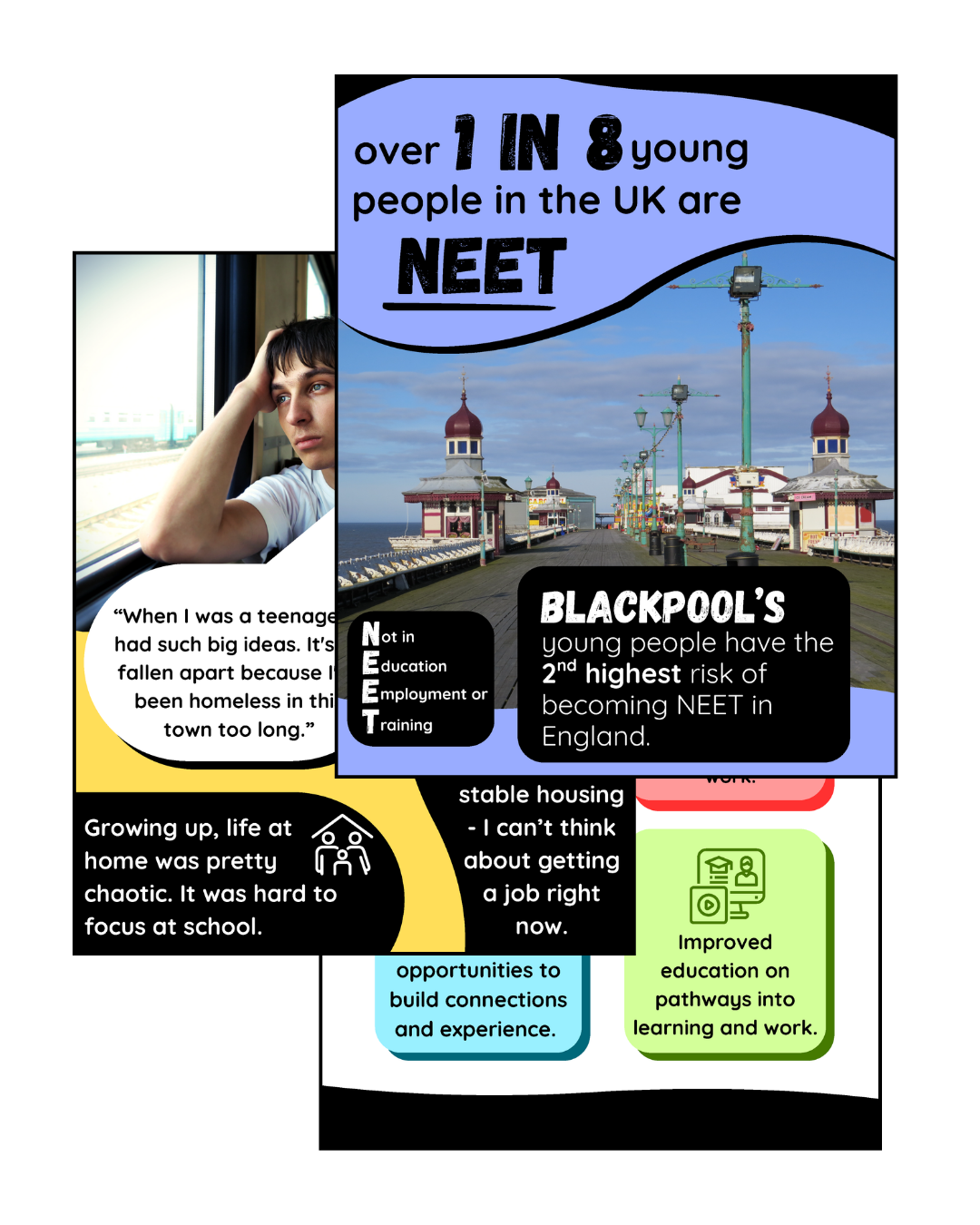
Young people in Blackpool with first-hand experience of being NEET helped us co-design a creative way to share these experiences too.
One size solutions don’t fit all
As well bringing the evidence to life, the personas showed why a one-size-fits-all approach is unlikely to work. Young people need tailored support that reflects the diverse circumstances they face.
Based on what we found, the report called for:
- Stronger local NEET-reduction partnerships with shared responsibility for improving young people’s outcomes. This could be carried out through effective data and case management which coordinates services into a fully integrated system, supported through central government funding and clear targets.
- A broader range of employment opportunities, which could be achieved through incentivising small and medium employers to recruit entry-level candidates, diversifying and expanding growth sectors, and a reduction of practical barriers to employment such as expensive travel.
- A stronger evidence base to better understand the needs of those facing the greatest barriers to work. This would mean further research into understanding complex family dynamics and psychosocial resilience. Plus, best practice guidance should be developed which aims to reduce the risk of disengagement, as well as supporting young people to expand their networks.
The insight and research resonated with policymakers and sector leaders. Reflecting on the findings, Lord David Blunkett said:
“This analysis gives us the kind of evidence which will inform coherent and joined-up interventions, and ensure we don’t have to keep on relearning lessons that have already been observed and understood.” – Lord David Blunkett.
But beyond the findings themselves, the project also reinforced an important lesson: meaningful change is built upon strong relationships. Trust and collaboration was central to how we conducted the research, and it will be just as important in delivering the joined-up, place-based support for young people in Blackpool.
The final report of the Young People and Work Review is due to be published in November this year. We are looking forward to seeing how the proposed national solutions align with our own findings in Blackpool.
Read the full report
Have a look at all the findings from our work with the Social Mobility Commission.
1 Young people not in education, employment or training (NEET), UK – Office for National Statistics
2 Young people and work: interim report – GOV.UK
³https://data.youthfuturesfoundation.org/dashboard/neet