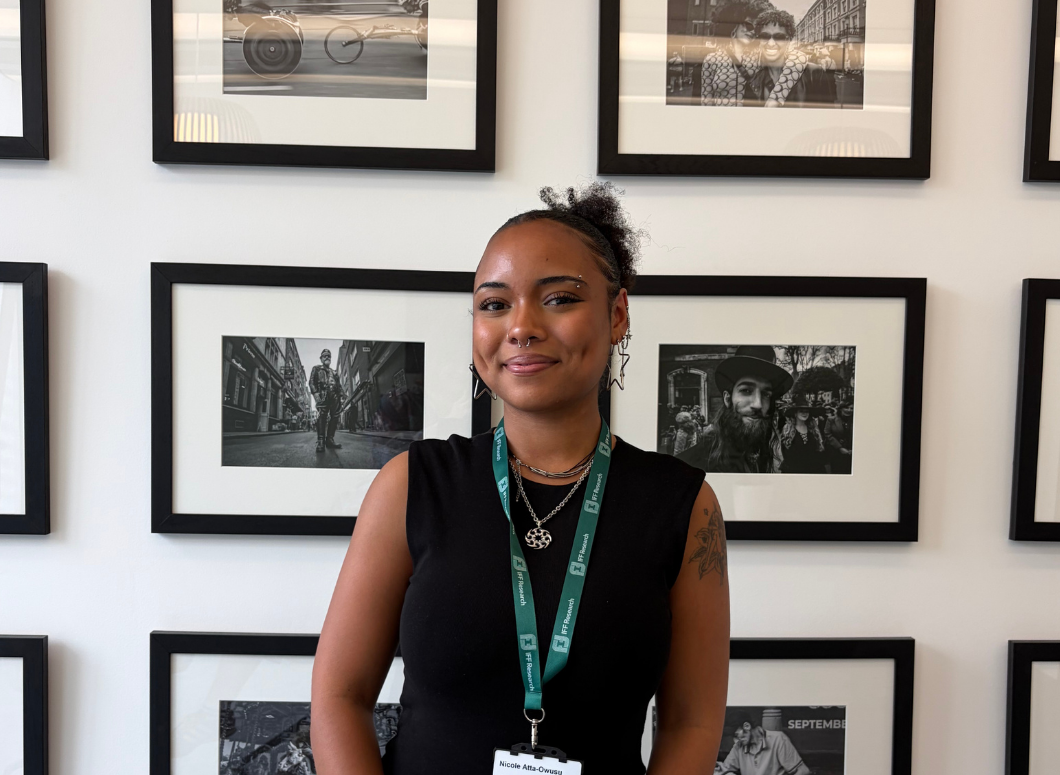
This summer, we welcomed Nicole Atta-Owusu to IFF through the 10,000 Interns Foundation’s Black Interns Programme. It’s a scheme that creates paid, practical opportunities for underrepresented young people to gain experience, build confidence and explore different career paths.
Over six weeks, Nicole got stuck into the world of social and market research with us, supporting live projects, developing new skills and getting a first-hand look at how research can shape decisions that affect people’s lives.
We spoke to Nicole about what drew her to the programme, what she’s taken from her time at IFF, and how the experience has helped shape what she wants to do next.
What attracted you to the 10,000 Interns programme, and what made you choose an internship in research?
I was attracted to their mission: enabling unrepresented talent and people access opportunities and build confidence in the job market. As a university student, like everyone else I was worried about the pressure of securing an internship. As a mixed-race student, I also recognised the possible additional challenges I may face and have felt overlooked in the past.
I had seen testimonials from students who had achieved their goals through the 10,000 Interns programme, which pushed me to apply myself. I was also completing a year abroad in Korea, where competing schedules and time zone differences often made internship applications difficult. Knowing I could focus on gaining experience during my year abroad, and not falling behind on applications, made my time away a lot less stressful.
Plus, research has always interested me as a student, and my degree has given me a strong grounding in it. But most of that experience has been academic, so I was keen to see what research looks like in a practical, real-world setting. I knew it’d be a great opportunity to build on those foundations, contribute meaningfully and develop the professional skills required for a future career.
Looking back on the summer, what’s been the biggest highlight for you, and why?
Honestly, the biggest highlight has been the work itself! Getting to work on projects where the research genuinely feeds into decisions that affect people’s day-to-day lives, made the experience feel real in a way I hadn’t expected.
As I said, before this summer, I knew I enjoyed research in an academic sense, but I wasn’t sure what that looked like as an actual career. Seeing projects through from start to finish — from designing the approach to understanding how the findings were used — showed me how research can lead to tangible, positive outcomes.
It’s given me a much clearer sense of direction, and I’m now seriously considering a career in social or policy research, somewhere I can keep working on projects that have that same weight behind them.
Has anything about working at IFF surprised you since starting the internship?
I’d heard a lot about IFF’s culture before joining, but I was still surprised by how strongly that came through day-to-day. I’ve never worked in an environment where discipline and compassion work hand-in-hand with each other so well.
Everyone recognises how important it is to be humane, understands their roles, and knows the importance of doing their part so work doesn’t fall unfairly on others.
I was welcomed so warmly, and have never felt afraid to ask for help and assistance. And even more than that, I felt people were genuinely interested in me as a person, not just a colleague.
What skills, knowledge or confidence do you feel you've developed during your placement?
I’ve developed lots of skills and confidence I didn’t have going into the internship.
On the technical side, I took part in training on sampling, which taught me how to think carefully about who we’re speaking to and why that matters for the reliability of research findings. I also had training in qualitative interviewing and learned how to create topic guides, which has been really valuable. I now have a much better understanding of how to structure a conversation so it draws out genuinely useful insights, rather than just surface-level answers.
Alongside that, I picked up practical skills I hadn’t expected to need, like coding, and became a lot more confident using Microsoft applications for daily tasks. Whether that’s for organising data to presenting findings clearly.
But beyond this, I feel like my confidence has grown the most. Learning how to apply these skills in a fast-moving, collaborative environment, and being trusted to contribute to real projects, has pushed me to trust my own judgement more. I feel far more comfortable now speaking up in meetings, asking questions when I don’t understand something, and presenting my ideas to colleagues. They’re all things I would have found daunting before the internship. These are skills I know I’ll carry with me into whatever I do next.
What advice would you give to others that might be thinking about applying for the 10,000 Interns programme?
My biggest piece of advice would be to stay open, patient, and proactive. The process can take a while, from sending your application to being matched with an organisation, so try not to get discouraged if you don’t hear back straight away. Trust that the programme is designed to give you the best possible chance, and that patience pays off.
I’d also really encourage people to make full use of the Foundation’s services before you even get to the application stage. They offer pre-application training, including CV and cover letter workshops, sector deep dives, and introductions to their partner organisations. They are all genuinely useful for building a stronger, more targeted application. I used these to sharpen my CV and get a better sense of which sectors might suit me, and it made a real difference to how confident I felt applying.
Take advantage of the mentoring and support on offer throughout the whole programme too. Ask questions, reach out to people, and don’t be afraid to admit what you don’t know yet. Everyone involved in the programme wants you to succeed, so the more you engage with what’s available, the more you’ll get out of it, both in terms of securing an internship and making the most of it once you’re there.
Could IFF be your next step?
It was a pleasure having Nicole with us at IFF. We wish her all the very best for what comes next. And, if she does pursue a career in social research, we’ve no doubt she’ll have brilliant contributions to make.
Find out more about what life at IFF is like: